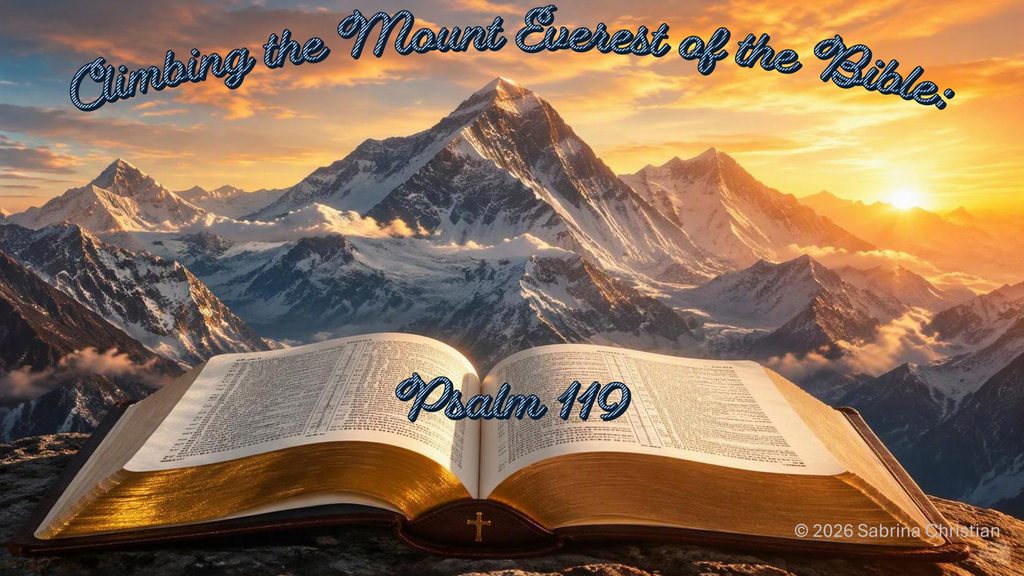
One of my research efforts—defining God’s Word—led me to Psalm 119. When I turned to that psalm, I groaned. Let’s be honest. Sometimes reading the Bible can be hard. Those Old Testament names can be tongue-twisters. The long census lists of who begat who can be boring. The intricate, very specific instructions for building the temple are mind-boggling.
But as I read Psalm 119 with my research question in mind, I received my answer. God’s Word for God’s people—a conclusion often recited after a scripture reading—is “all up and through” Psalm 119. I was amazed by the various ways the Psalter tells me to obey God. Not only did I find what I was searching for, but I also found joy in reading that psalm. Today my goal is to encourage you to read Psalm 119 with joy and expectation.
The Superlatives
Psalm 119 is often called the Mount Everest of the Bible. Both are superlatives: the longest chapter in the Bible, the tallest mountain on this planet. Reaching the pinnacle of each results in a sense of accomplishment, but more importantly, a spectacular view of God. But therein the similarity ends. Reaching Everest’s peak is daunting, expensive, time-intensive, and dangerous. To use those adjectives for Psalm 119 would certainly discourage anyone from reading it, especially since the shortest chapter, Psalm 117, is nearby.
The superlative “longest” caused me to groan; however, God had directed me to Psalm 119, so I prepared to climb. How can we reach the Bible’s pinnacle? Why should we try? Let’s look at what Psalm 119 offers us.
Prepare for the Climb: An Overview
Structure
Psalm 119 is an acrostic poem arranged in Hebrew alphabetic order—a stanza per letter. (The Bible has eight acrostic psalms.) Each stanza has 8 verses. Each verse in a stanza starts with the same Hebrew letter. For example, stanza 1, verses 1-8 begin with the first Hebrew letter Aleph; stanza 2, verses 9-16, the second Hebrew letter Bet[1] and so forth. With 22 letters, Psalm 119 has 176 verses—the longest chapter in the Bible.
Classification
Psalms fall into four categories: lament, praise, thanksgiving, and wisdom. Psalm 119 is a wisdom psalm. It is an explicit, didactic tribute to God’s Word. Like the book of Proverbs, Psalm 119 focuses on how to live a Godly life and on what happens when we do.
Person
The first four verses are in third person. The Psalter speaks of those who are blessed because they follow God’s Word. Starting with verse 5, Psalm 119 becomes personal. It is first person, I. The writer expounds on what he can and should do to remain under God’s grace and care, and how God responds.
Words of God
Researching “God’s Word for God’s people” is what led me to Psalm 119. What I find most intriguing is that this psalm includes all forms of God’s Word. Within this psalm, we have words that:
- Give thanks for the blessings when we obey God
- Guide our daily living under God
- Acknowledge the promises of God
- Offer refuge and solace when under attack
- Serve as an anchor
This list represents the many forms of God’s Word in Psalm 119.
| Law | Word | Precept |
| Statute | Decree | Testimony |
| Commandment | Judgement | Rule |
| Ordinance | Way | Works |
The different Bible translations treat these words as synonyms. Compare verse 2:
Blessed are those who keep His testimonies[2], Who seek Him with the whole heart! (NKJV)
Blessed are those who keep his statutes and seek him with all their heart (NIV)
Happy are those who keep his decrees, who seek him with their whole heart, (NRSVUE)
Happy are those who keep his rules, who try to obey him with their whole heart. (NCV)
Conversely, God’s Word in verse 105, an often quoted scripture, is the same in all English translations:
Your word is a lamp to my feet And a light to my path. (AMP)
The goal isn’t to debate the wording, but to obey the underlying instructions. Choose the translation that speaks to your soul.
Reaching the Pinnacle
When you read this psalm, read it as God’s direct word to your ears. It is written in first person, so read it not as if some nameless person wrote it, but as if you wrote it. Make Psalm 119 your personal poem of commitment to God.
This could be your daily Bible study: read a stanza a day for 22 days. Read it aloud. You will notice repetitions and similarities that reinforce the messages. For example, v1 and v59 allude to walking in God’s way. As you read, identify the main idea(s) in that stanza.
Read it in totality. It is a poem, so add your own rhythm to it. How can that rhythm help embed the precepts of Psalm 119 in your daily living?
Conclusion
Set aside some time and enjoy the words of God. If you’ve read Psalm 119 before, please read it again with a new lens.
[1] We usually equate testimony with our witness of God’s hand in our life. In Psalm 119, it means God’s “witness” of his expectations for us.
[2] Some Bible translations, such as the New International Version (NIV), include the Hebrew letters at the start of each stanza.

When I think about reading the Bible it is a daunting challenge indeed. I always wondered what each verse represented. This was a wonderfully written definition and Google map 😂 of how it should be read in order to achieve understanding. Well done.